
The most common objectives are: sales in dollars and square meters, gross/net profit, market share, brand awareness, etc.
Factories must develop objectives for their brands in the distribution channel and on the Internet, which are the places visited by the customer throughout the year; because trade fairs and exhibitions represent only a few days, and their focus is on the professional public.
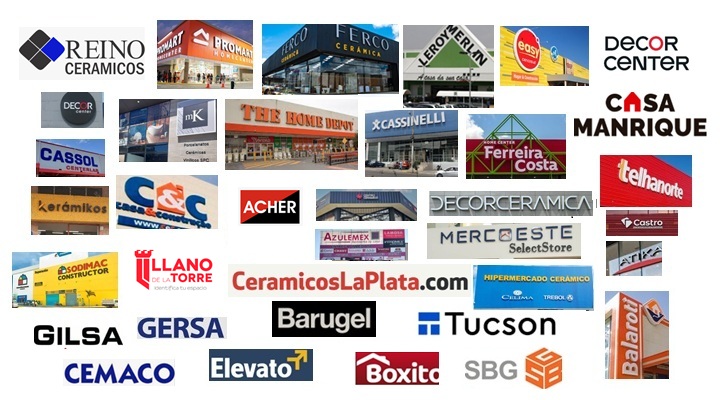
The objectives that strengthen a brand’s market positioning are:
- Physical and weighted distribution of its brands.
- Quality of display in the distribution channel.
- Stock availability (m2) for each SKU.
- Backlinks: number of links pointing to the brand.
- Backlinks to SKUs on e-commerce sites.
1. Physical and Weighted Distribution of Your Brands
For a mid-to-low priced brand, it is imperative to have broad market coverage (high physical distribution). For a high-priced brand, selective coverage is expected.
- Physical Distribution shows how many points of sale carry a SKU, out of the total number of points of sale.

Example: Calacata 60 x 120 (Brand X)
If there are 1100 stores in an area that sell Calacata-type products, and the Calacata 60 x 120 SKU of Brand X is available for sale in 745 stores, its physical distribution is 68%.
- Weighted Distribution considers the market share of each store. It takes into account how many prime locations a given SKU is in, because not all stores sell the same quantity of ceramic and porcelain tiles. Some small stores sell less than 3,000 m²/month, while others sell more than 15,000 m²/month.

Example: Calacata 60 x 120 (Brand X)
If Brand X sells $4,700,000 worth of Calacata 60 x 120 in a given period, and the total sales of the Calacata category, including all brands in the market, are estimated at $11,000,000, then the Weighted Distribution for Brand X of Calacata 60 x 120 will be 43%.
Distribution (physical and weighted) should be measured by SKU and then consolidated for the brand’s total.
Mass market companies pay close attention to these metrics (measured by Nielsen) because they are the foundation of their business.
In the ceramics industry, an outlandish number of SKUs are manufactured, many of which are not in demand. This makes any kind of measurement difficult; even so, some factories measure their physical distribution by sampling and estimate the weighted distribution for «A» type SKUs (Pareto). The rest do not pay attention to these metrics.
“What gets measured gets managed» Peter Drucker
A brand’s value is closely tied to its physical and weighted distribution. It’s like the «to be or not to be» in a factory’s business.
2. Quality of display in the distribution channel.
What isn’t displayed doesn’t sell.
What is displayed sells.
What is well displayed sells more.
Measure the display at the point of sale!
3. Stock availability (m2) for each SKU.
It’s proven: visually displaying physical stock sells more than promising it from a screen.
Don’t promise! Show the benefit: stock availability in the channel.
4. Backlinks, the number of links pointing to the brand.
Every link (or hyperlink) that sends users to the company’s website, in addition to a potential sale, is for Google and other search engines a vote of confidence that contributes to the brand’s positioning and authority.
The best website in the construction industry is Weber’s (Saint Gobain), which replicates the success of «The Weber Guide,» an excellent idea that complements an aggressive distribution strategy.
The Weber site attracts backlinks from (unpaid) recommenders and generates enormous authority for Google and Artificial Intelligence.
In the ceramics industry we find institutional sites that are static, boring and very similar to each other.
Instagram and other (third-party) social media have been prioritized at the expense of strengthening the company’s own website.
Backlinks from social media to factory websites are scarce.
It’s not enough to know how many backlinks your website has; you also have to monitor those of your competitors.
5. Backlinks to SKUs in E-commerce
The most productive link or backlink is the one that sends the user to a SKU in an e-commerce store; it’s an invitation to buy something specific.
How many stores have e-commerce? More and more, regardless of the Latin American country. The customer enters the website, and if they don’t want to make an online purchase, they’re redirected to WhatsApp, but the message is that the SKU is in stock.
Why isn’t this form of promotion used more intensively?
Too much budget and effort is spent accumulating «likes» on social media, which no one knows where they end up.
Pushing sales teams to the limit doesn’t produce results.
The drivers of sales in the medium to long term are the commercial strategies and resources allocated to the aforementioned objectives.
Author: Julio Sol
SKU Marketing! Focus on Your Own Websites!
